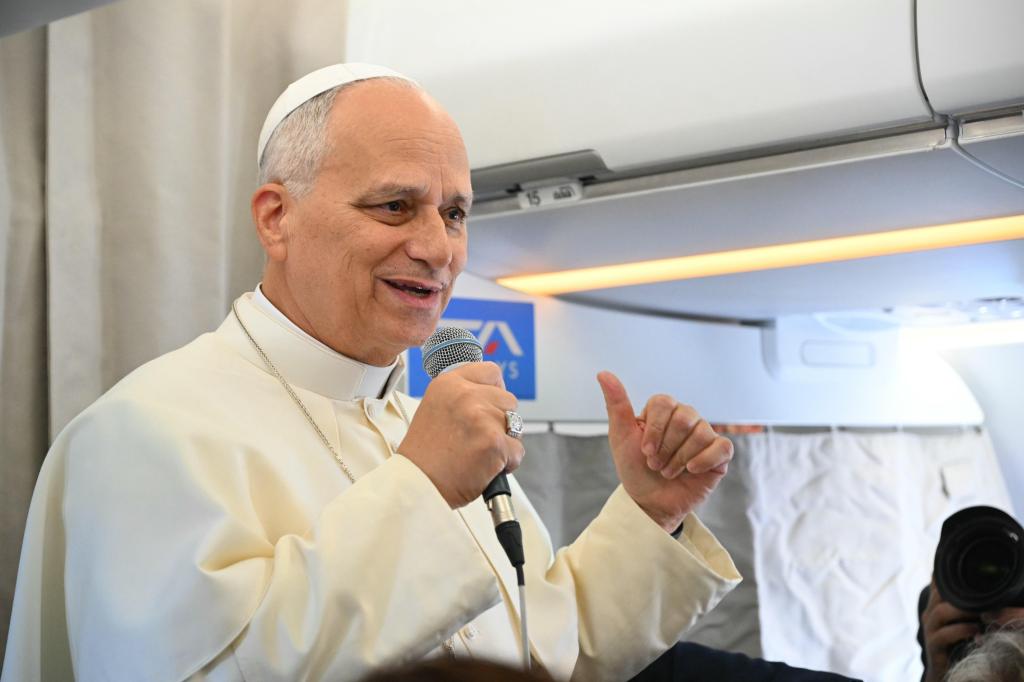

ABOARD THE PAPAL PLANE — On a brief flight from Istanbul to Beirut, Pope Leo XIV used his first inflight news conference as pope to reaffirm the Holy See’s position that a two-state solution remains the only way to secure justice for both Israelis and Palestinians. The encounter, held during the second leg of his maiden papal trip, was limited to two questions from Turkish journalists because of the short flight time.
Asked about private talks with Turkish President Recep Tayyip Erdogan, the pope confirmed they had discussed both the Gaza and Ukraine conflicts and said Turkey has an important role to play. He noted Ankara’s facilitation of low-level contacts between Russia and Ukraine and urged continued dialogue to pursue a ceasefire and an end to the nearly four-year war.
On Gaza, Leo reiterated the Vatican’s long-standing support for a Palestinian state in east Jerusalem, the West Bank and Gaza, calling that outcome the only viable resolution to the dispute. The Holy See recognized a Palestinian state in 2015, and momentum behind a two-state outcome increased during this year’s Israel-Hamas war, with several countries formally recognizing Palestinian statehood at the U.N. General Assembly.
“We know that in this moment, Israel doesn’t accept this solution, but we see it as the only one that can offer a solution to the conflict that they are living in,” the pope said, adding that the Holy See counts itself as a friend of Israel and seeks to be a mediating voice to help both sides reach a just settlement.
There was no immediate response from Israeli Prime Minister Benjamin Netanyahu’s office. Netanyahu has long warned that creating a Palestinian state would empower Hamas and create a larger hostile presence on Israel’s borders; earlier this month he restated that Israel’s opposition to a Palestinian state has not changed.
During his visit to Turkey, the pope largely avoided detailed public discussion of the Gaza war and made no mention in his brief remarks of his visit to Istanbul’s Blue Mosque. Instead, he emphasized the trip’s main purpose: marking the 1,700th anniversary of the Council of Nicaea, held in present-day Iznik in A.D. 325. That council produced the Nicaean Creed, a common statement of faith still recited by many Christians and a rare point of unity among Catholic, Orthodox and many Protestant believers.
Leo took part in the Iznik commemoration and met with Orthodox patriarchs. At a joint meeting, he proposed a major 2033 gathering in Jerusalem to mark 2,000 years since Christ’s crucifixion and resurrection as a visible sign of Christian unity, saying the idea was welcomed and that there is time to prepare for such an event.


