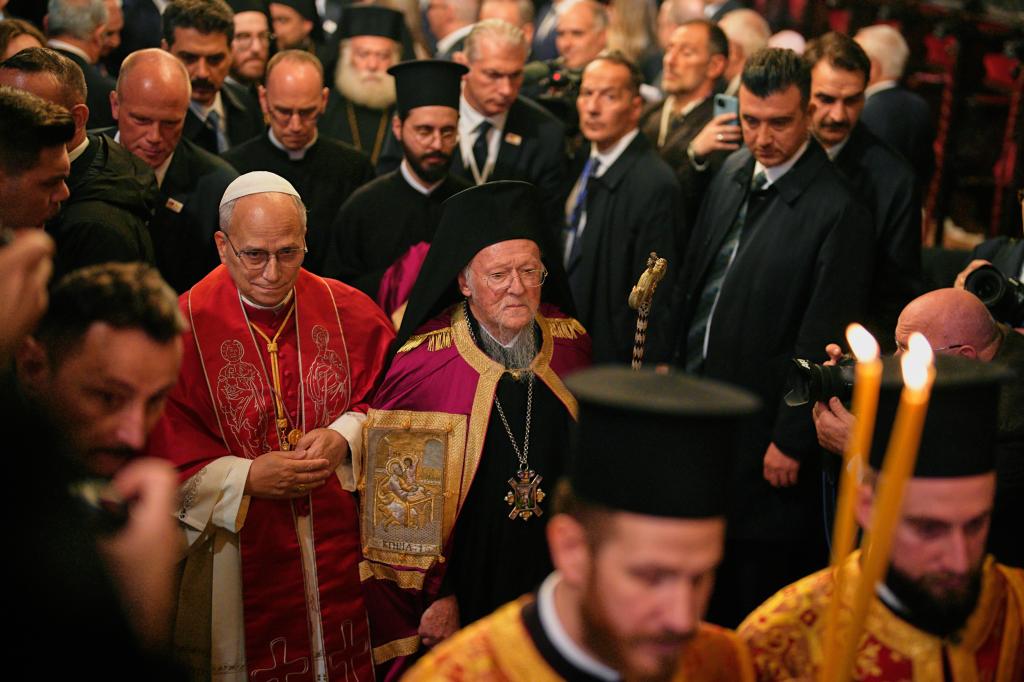

BEIRUT — Pope Leo XIV urged Lebanon’s political leaders to rise above factional rivalries and become genuine peacemakers during a visit meant to offer hope to a country battered by economic collapse, political paralysis and the threat of renewed conflict.
Arriving in Beirut from Istanbul on the second leg of his first papal trip, Leo sought to encourage Lebanese to persevere and to strengthen a key Christian community in the Middle East. His visit fulfilled a promise by his predecessor, Pope Francis, who had planned but been unable to travel to Lebanon because of the country’s instability and failing health.
Lebanon’s sectarian power-sharing system has frequently produced stalemate, lengthy vacancies and deadlocked investigations into crises such as the devastating Aug. 4, 2020, port explosion. The nation remains deeply divided over demands that Hezbollah, the powerful militant and political movement, disarm after last year’s fighting with Israel.
Speaking at the presidential palace, Leo acknowledged the widespread suffering caused by economic hardship, regional instability and intensifying identity conflicts. He urged leaders to pursue truth and reconciliation with those harmed by injustice, and said a culture of reconciliation must be modeled from the top: public officials should set aside narrow interests and place the common good ahead of personal advantage.
A central moment of the pope’s visit was scheduled for Tuesday, his final day, when he planned silent prayer and meetings with victims at the site of the 2020 port blast. For many Lebanese, the pope’s presence alone signaled that their plight had not been forgotten, a sentiment voiced by local church leaders.
Security around the trip was tight. Leo’s plane was escorted into Beirut by a Lebanese military jet, and he was received at the airport by President Joseph Aoun, Parliament Speaker Nabih Berri and Prime Minister Nawaf Salam. He traveled through the capital in a closed popemobile along a route lined with troops and monitored by a helicopter — a contrast with the open-vehicle appearances favored by his predecessor. Vatican officials declined to comment on vehicle protection.
The visit came a week after an Israeli strike in Beirut killed five people, including a senior Hezbollah figure. As the papal convoy reached the presidential palace, a dance troupe performed dabke despite heavy rain.
Earlier in his trip, Leo had marked an important Christian anniversary in Turkey, where Ankara has been active as a mediator in talks related to Ukraine and Gaza. In Lebanon he aimed to reassure citizens disillusioned with their leaders and to encourage Christians to remain in or return to their homeland. Lebanon is a Muslim-majority country where roughly a third of the population is Christian; the community has dwindled in recent decades amid violence and economic decline, making Lebanon a Vatican priority.
The pope told authorities that while the Lebanese diaspora can offer much, staying in the country is essential to help build what he called a civilization of love and peace — a sentiment echoed by parishioners who said his visit brings comfort.
Even after a U.S.-brokered cease-fire last year ended a two-month war between Israel and Hezbollah, Israeli strikes have continued at a near-daily pace to try to prevent the group’s rearmament. That conflict killed more than 4,000 people in Lebanon and left widespread damage. Residents expressed hope that the pope’s visit would not be followed by further violence.
Hezbollah urged the pope to condemn what it called injustice and aggression against Lebanon and mobilized supporters to line the papal route, passing bombed buildings from the recent war. Hundreds turned out waving Lebanese and Vatican flags. A leader of a Hezbollah-affiliated scouting group said their presence was meant to underscore coexistence and national unity.
Hezbollah is allied with several Christian parties, including the Free Patriotic Movement and the Marada Movement, while the largest Christian parliamentary bloc, the Lebanese Forces, opposes the group and blames it for drawing the country into conflict.
A delegation of about 300 Syrian Christians, led by a Greek Melkite Catholic priest, traveled to Beirut to join a youth audience with the pope and attend a public Mass on the waterfront. Young attendees said the visit offered reassurance to Christians across the region and expressed a wish that the pope might also visit Syria to comfort believers there.
The pope’s message emphasized reconciliation, high-minded leadership and solidarity with ordinary Lebanese struggling amid uncertainty — an appeal to political elites to act for the common good at a time when many citizens fear for the future of their country.


