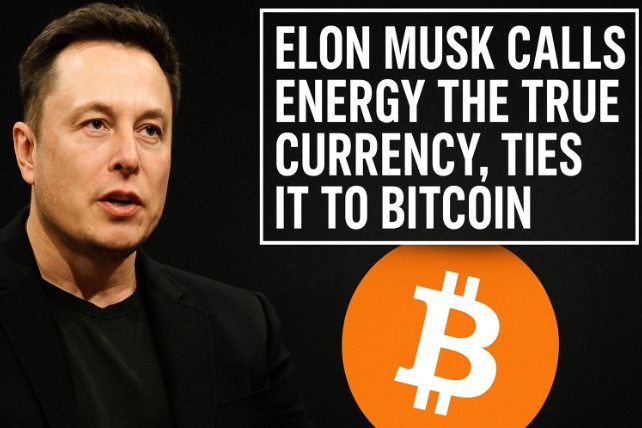

Elon Musk recently argued that energy, not fiat money, should be seen as the “true currency,” and used that frame to explain Bitcoin’s value. His comments reignited discussion about what ultimately underpins cryptocurrencies, especially against a backdrop of large-scale fiscal and tech spending, inflation concerns, and debates over energy use.
Why energy, not fiat?
Musk responded to a remark about global spending on AI and stimulus by saying, in essence, that you cannot “print” energy. He contrasted physical energy—measurable and tied to real production—with fiat currencies, which governments can expand through monetary policy. His point: when value is grounded in a physical input like energy, it is less susceptible to arbitrary expansion or debasement than money created by decree.
Bitcoin as energy-backed money
Musk linked this view to Bitcoin’s proof-of-work system, which requires significant electrical energy to mine new coins by solving computational puzzles. He portrayed that energy expenditure as an anchor for Bitcoin’s value: because energy must be produced and consumed, it imposes a real cost that can’t be faked, in contrast to fiat issuance. In that light, Bitcoin becomes a “physics-based” or “energy-based” form of money rather than purely symbolic ledger entries.
Inflation and the debasement argument
Those remarks came amid concerns that heavy public and private spending—on AI infrastructure and other projects—could intensify inflationary pressures or currency debasement. Framing Bitcoin as tied to energy is presented as a potential hedge: its limited issuance schedule and the tangible energy required to secure the network impose constraints that fiat systems do not.
Musk’s evolving crypto stance
Musk’s position on cryptocurrency has shifted over time. He once signaled support and Tesla briefly accepted Bitcoin, then reversed that decision citing environmental concerns around mining. Now he appears to reframe mining’s energy use as a source of value rather than solely an environmental liability, reflecting a nuanced and evolving view.
Why the argument matters — and objections
Musk’s framing matters because of his influence in tech and markets; his views can shape public perception. Still, the “energy-as-currency” thesis is controversial. Critics point to the environmental and social costs of high energy consumption—especially if sourced from fossil fuels—and question whether energy expenditure alone ensures stable, long-term monetary value or sustainable scalability. Others argue alternative consensus mechanisms or energy-efficient designs might offer different trade-offs.
Ultimately, Musk’s remarks challenge traditional ideas about what gives money worth, prompting renewed debate about whether measurable physical inputs like energy should play a central role in monetary systems. Whether one agrees, the perspective forces reconsideration of how value is defined in a complex, resource-constrained global economy.


