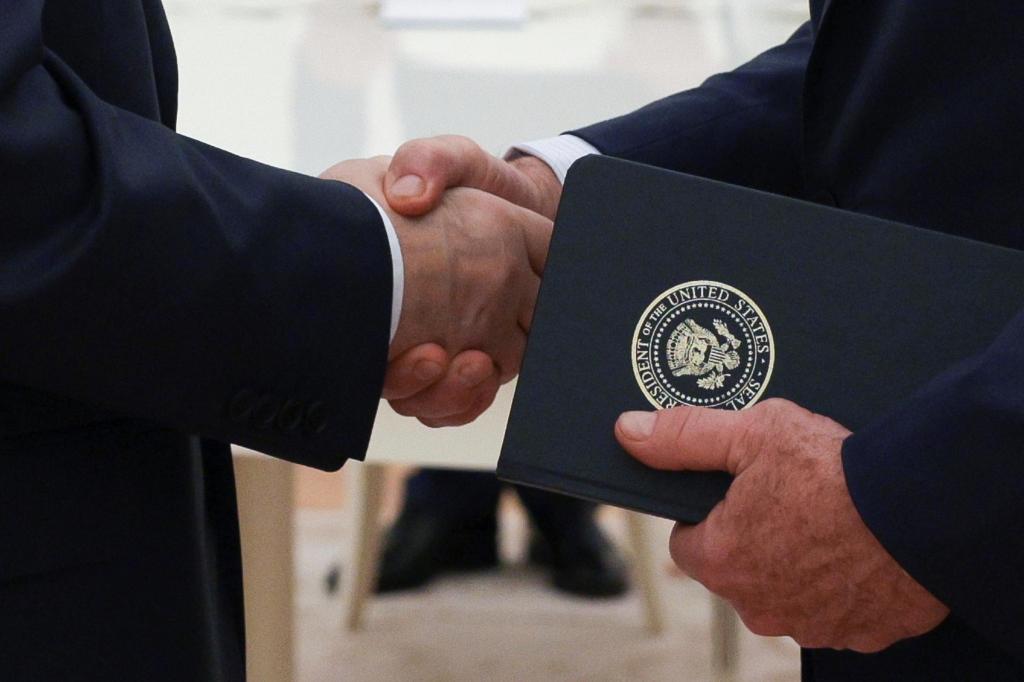

Diplomats are struggling to reconcile Moscow and Kyiv’s red lines as a renewed U.S.-led push to end the war advances. U.S. envoys met Ukrainian officials over the weekend, and American representatives are expected in Moscow this week, after President Donald Trump’s peace plan was published last month and revised following U.S.-Ukraine discussions in Geneva.
The revised plan produced mixed reactions. Ukrainian President Volodymyr Zelenskyy called it potentially workable, Russian President Vladimir Putin said it could serve as a basis for agreement, and Trump said there was a good chance of striking a deal. Yet major obstacles remain, centered on whether Ukraine would cede territory and what security guarantees it would obtain.
U.S. envoys held a roughly four-hour session with senior Ukrainian officials, including Rustem Umerov, the head of Ukraine’s national security council, Andrii Hnatov, presidential adviser Oleksandr Bevz and others. A senior U.S. official described the meeting as productive but said much work remains; Umerov thanked the United States for its support while disclosing few specifics.
Andrii Yermak, the former presidential chief of staff and lead negotiator who participated in the Geneva talks, resigned amid a corruption scandal and is no longer on the negotiating team. Trump said he would send envoy Steve Witkoff to Moscow, and the Kremlin confirmed Putin will meet him. Questions arose after reports that Witkoff coached a Russian aide on presenting the plan to Trump, though both Washington and Moscow downplayed those accounts.
Where the sides stand
Both Kyiv and Moscow have publicly welcomed renewed diplomacy, but fighting has continued and Russia has pressed maximalist demands. Putin has said he will press on until Ukrainian forces withdraw from the four regions Russia annexed in 2022 but does not fully control, and has indicated Russia would use force if Kyiv does not comply. He described the U.S. proposal as a possible starting point that requires serious discussion.
Zelenskyy has thanked Trump for the initiative while stressing Europe’s role and the need for robust security guarantees. Kyiv rejected aspects of the initial U.S. draft that it viewed as unacceptable, including requirements to cede territory not fully occupied by Russia and to abandon hopes of NATO membership. Zelenskyy has repeatedly said giving up land is not an option. Bevz said the president wants to discuss territorial questions directly with Trump, and Yermak told The Atlantic that Zelenskyy would not sign away Ukrainian territory.
On security, Kyiv argues that NATO membership is the most reliable guarantee; NATO members have said Ukraine is on an irreversible path toward the alliance. Trump has indicated that NATO membership for Ukraine is off the table. Moscow opposes any Western peacekeeping presence on Ukrainian soil and has framed excluding Ukraine from NATO as a core war objective.
Pressure and perceptions
Zelenskyy faces domestic pressure after Yermak’s resignation—an episode some saw as a necessary shake-up even though neither of the men has been formally accused of wrongdoing. He has said Ukraine will avoid mistakes and continue its struggle. Putin has portrayed confidence, highlighting battlefield gains and, according to analysts, appears willing to wait for Kyiv to accept terms more favorable to Moscow. Analysts including Tatiana Stanovaya of the Carnegie Russia and Eurasia Center say the Kremlin is watching to see whether U.S. diplomacy can move Kyiv toward Russian terms; if not, Moscow feels prepared to pursue its goals by other means.
Europe’s dilemma
NATO and EU meetings this week are focused on Ukraine, and Zelenskyy is scheduled to meet French President Emmanuel Macron. In Brussels, EU and NATO ministers will debate military aid, defense readiness and broader support. A key European issue is what to do with frozen Russian assets held in Belgium. An early U.S. draft proposed using some of those funds for post-war investment in Ukraine. European Commission President Ursula von der Leyen favors such a plan to sustain support for Kyiv while keeping pressure on Moscow, but Belgium’s prime minister has warned of legal risks, potential effects on the euro and possible Russian retaliation.
Observers say the U.S. initiative has exposed European diplomatic weaknesses: despite being the main source of Ukraine’s economic and military backing, Europe has been largely marginal to the drafting process and has mainly proposed amendments to the American text, according to Nigel Gould-Davies of the International Institute for Strategic Studies.
Outlook
Despite public optimism from leaders, deep disagreements over territory and security persist. With talks shuttling among Washington, Kyiv and Moscow and European capitals weighing legal, financial and political implications, diplomats face a long and delicate negotiation to bridge positions that for now remain far apart.


