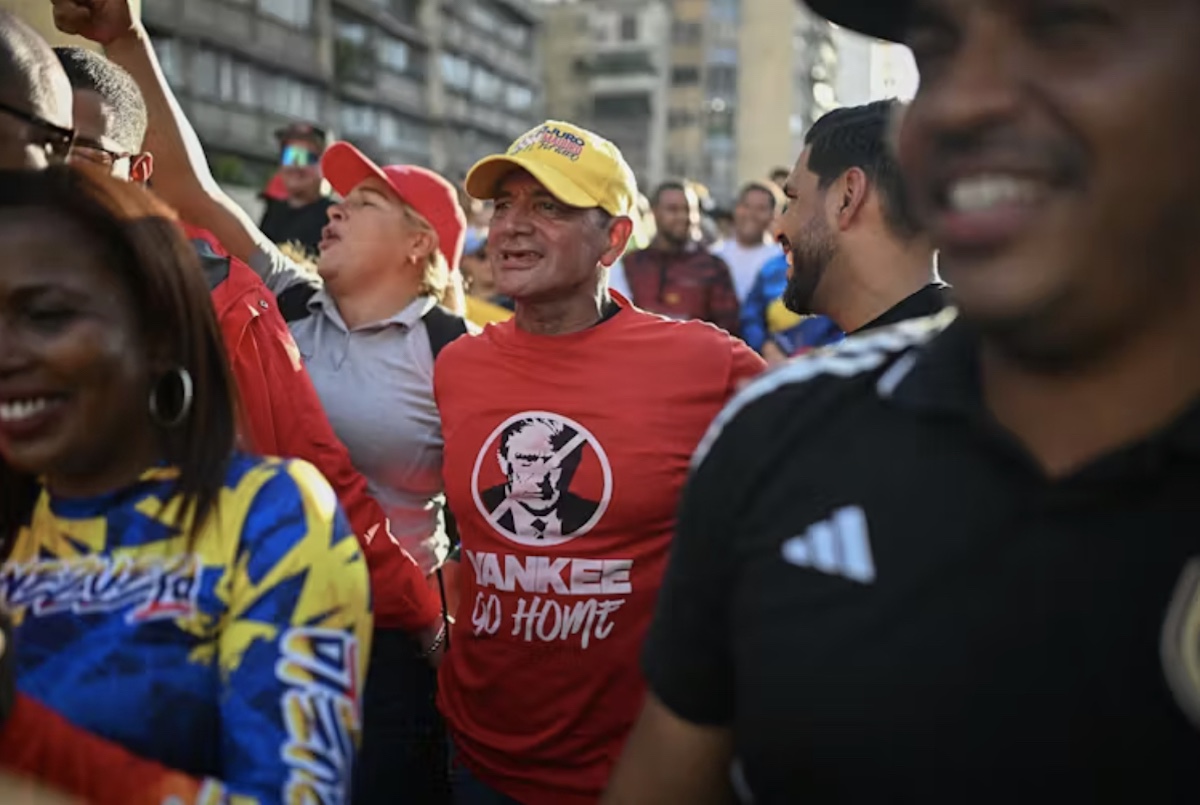

A large U.S. naval deployment into the southern Caribbean has revived fears that Washington may be returning to direct intervention in Latin America. While President Donald Trump has publicly downplayed plans for strikes inside Venezuela and framed recent naval actions as aimed at countering drug trafficking, the arrival of the USS Gerald R. Ford and accompanying forces will nonetheless expand U.S. power projection in the region.
As a historian of U.S.–Latin American relations, I see these moves as rooted in a long pattern of American coercion in the hemisphere. If maritime incidents escalate into clashes with Venezuelan forces or lead to attempts at regime removal, such steps would echo earlier practices of using military force to influence outcomes across the Americas. But this moment is distinctive in ways that could do lasting damage to U.S. ties throughout Latin America.
Sending a naval flotilla to the Caribbean recalls “gunboat diplomacy” — the use of ships and landing forces to intimidate governments or effect political change. From the late 19th century through much of the 20th, the United States repeatedly intervened in Caribbean and Central American affairs. Between 1898 and the 1990s, U.S. forces were involved in dozens of operations, some overtly aggressive and others bolstering authoritarian rulers. Those campaigns often produced regime topplings and heavy civilian tolls—for example, the U.S. occupation of Haiti from 1915–1934, which likely caused many thousands of deaths.
Through World War II and the Cold War, interventions were frequently justified as protecting investments or blocking rival ideologies, with Washington supporting anti-leftist coups and dictatorships. Franklin Roosevelt’s 1930s “Good Neighbor” rhetoric reduced the most overt invasions for a time, but Cold War imperatives soon revived interventionist policies in places such as Guatemala and Grenada. After 1994, U.S. military activity in the hemisphere typically occurred in multilateral contexts or with host-nation consent and emphasized cooperation on issues like counternarcotics.
Respect for sovereignty and non-intervention became more pronounced as drug-related violence surged across the region; that shift made many Latin American governments, even those working with the United States, wary of unilateral military moves. Yet the current posture toward Venezuela cannot be dismissed as merely another invocation of the Monroe Doctrine. Two distinctions make a U.S. operation against Venezuela especially consequential.
First, a strike or invasion would invert the traditional Monroe Doctrine rationale. Originally meant to keep outside powers from meddling in the Americas, over time the doctrine morphed into a license for the United States to police the hemisphere itself. That logic animated interventions from Guatemala in 1954 to the Bay of Pigs to operations in the Dominican Republic and Grenada. During the Cold War, the threat of Soviet influence gave the policing impulse a geopolitical cover. In the post–Cold War era, the 1989 invasion of Panama to depose Manuel Noriega — a narco-convicted, repressive leader — remains one of the clearest examples of the U.S. asserting its prerogative to act without an external great-power pretext. The rhetorical parallels are worth noting: Noriega was presented as both criminal and illegitimate, and Trump has repeatedly characterized Nicolás Maduro in similar terms, at times linking him to organized criminal groups and suggesting ties to gangs labeled as terrorist organizations by U.S. authorities. Framing regime removal as a counter-narcotics or counterterrorism necessity thus becomes an easier political argument.
Second, any U.S. campaign against Venezuela would be far more complex and hazardous than Panama. Venezuela is much larger geographically and demographically, and it maintains a more substantial military than Panama ever did. An effort to force Maduro from power would likely encounter widespread resistance and could ignite prolonged, intense conflict. Maduro’s calls to mobilize supporters might overstate his capabilities, but analysts warn that intervention could devolve into a drawn-out struggle. The prospect of foreign assistance to Caracas from states such as Russia, China, or Iran — even if limited — complicates operational planning and raises the risk of broader confrontation.
Leaders across Latin America have expressed unease. Even governments critical of Maduro have balked at the idea of external military intervention. Presidents in Colombia and Mexico publicly criticized U.S. strikes, and others have warned that resorting to force to remove leaders will breed resentment throughout the hemisphere. Opposition to intervention is informed both by historical memories of U.S. interference and by contemporary political calculations: many left-leaning governments already mistrust Washington and would see unilateral action as an existential threat to regional sovereignty norms. As Brazil’s president has warned, if powerful states feel free to invade weaker ones, respect for sovereignty quickly erodes.
The Trump administration’s public justification emphasizes counter-narcotics operations, yet Venezuela is not the region’s largest producer or transit hub for illicit drugs compared with other countries. If Washington expands the logic of intervention — targeting states judged to be corrupt or compromised by drug trafficking — the result could be a domino effect across Latin America, with successive leaders vulnerable to foreign coercion under the banner of combating crime.
Historically, U.S. forces have intervened in parts of Latin America, occupied cities, and even crossed borders into Mexico, but the United States has never attempted to occupy or directly invade a major South American country. Past experiences suggest such operations are costly, frequently counterproductive, and liable to inspire long-term resistance. A U.S.-initiated regime change in Venezuela risks triggering mass insurgency, deepening regional hostility toward Washington, and leaving scars that will endure for decades.
Alan McPherson is a professor of history at Temple University.
This article was republished from The Conversation under a Creative Commons license.


