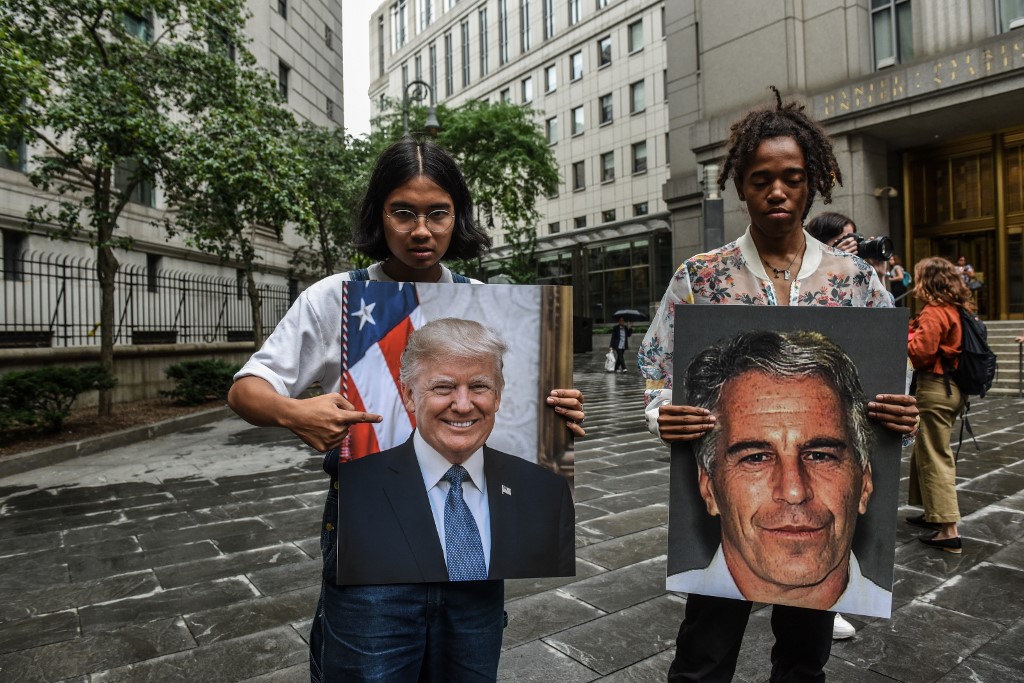

House Democrats investigating Jeffrey Epstein on Wednesday released three emails they say suggest President Donald Trump knew about the financier’s abuse of underage girls as early as 2011. The messages were part of roughly 23,000 pages of material the committee says it received from Epstein’s estate.
One 2011 email from Epstein to Ghislaine Maxwell, cited by Democrats, says Trump “spent hours at my house” with a victim whose name is redacted; in the same message Epstein called Trump the “dog that hasn’t barked.” A 2015 exchange between Epstein and journalist Michael Wolff discusses reports that CNN planned to ask Trump about his ties to Epstein and how to “craft an answer.” Wolff suggested that if Trump denied ever flying on Epstein’s plane or visiting his house, that denial would create “valuable (public relations) and political currency.”
In a January 2019 email to Wolff, Epstein referred to a redacted victim as having been at Trump’s Florida estate and at Mar-a-Lago, writing that Trump had asked Epstein to resign and that “Of course he knew about the girls as he asked ghislaine to stop,” according to the document released by Democrats.
The White House response, delivered by press secretary Karoline Leavitt, rejected any implication of wrongdoing, saying the emails “prove absolutely nothing other than the fact that President Trump did nothing wrong.” Leavitt noted that both men lived in Palm Beach, reiterated that the White House considers Epstein a “pedophile” and “a creep,” and pointed to what it describes as a falling out that led to Epstein’s expulsion from Mar-a-Lago after allegations that young women working at the club’s spa were recruited.
House Oversight Committee Ranking Member Robert Garcia said the newly released emails raise “glaring questions” about what else the White House may be withholding and about the nature of Trump’s relationship with Epstein. He urged the Department of Justice to release the full Epstein files and said the committee will continue pressing for answers and justice for victims.
Republican committee leaders quickly posted links to an additional set of files — about 20,000 pages from Epstein’s estate — on Google Drive and Dropbox.
The committee’s bipartisan inquiry gained momentum after the FBI issued a memo this summer saying the Justice Department would not release additional material from the government’s sex-trafficking investigation of Epstein. Epstein died in an apparent suicide in a Manhattan jail cell in August 2019 while awaiting federal trial.
The FBI decision not to release more documents sparked broad demands for disclosure from across the political spectrum, including some conservative media figures and Trump supporters. Trump campaigned on making the so-called “Epstein files” public. A bipartisan effort in the House to force a floor vote to release the files picked up steam after Speaker Mike Johnson swore in Arizona Democrat Adelita Grijalva; Johnson said the discharge-petition vote would be held next week. Grijalva provided the final signature on a petition started by Reps. Thomas Massie (R-Ky.) and Ro Khanna (D-Calif.) calling for a vote to release all investigation files related to Epstein.
Massie and Khanna previously held a Capitol press conference that included several women who described being abused by Epstein and Maxwell.
Since the FBI memo, scrutiny of Trump’s past connections to Epstein has intensified. Trump has denied reports linking him to the case and sued The Wall Street Journal over an item alleging he sent Epstein a suggestive doodle and message on a 50th-birthday card. The Journal also reported that then-Florida Attorney General Pam Bondi briefly told Trump in May that his name appeared in Epstein case files; the report did not clarify the context. Trump has denied the reports.
This story was originally published by the Louisiana Illuminator and has been updated to note that the discharge-petition vote is scheduled for next week after Representative Adelita Grijalva was sworn in and signed the petition.


