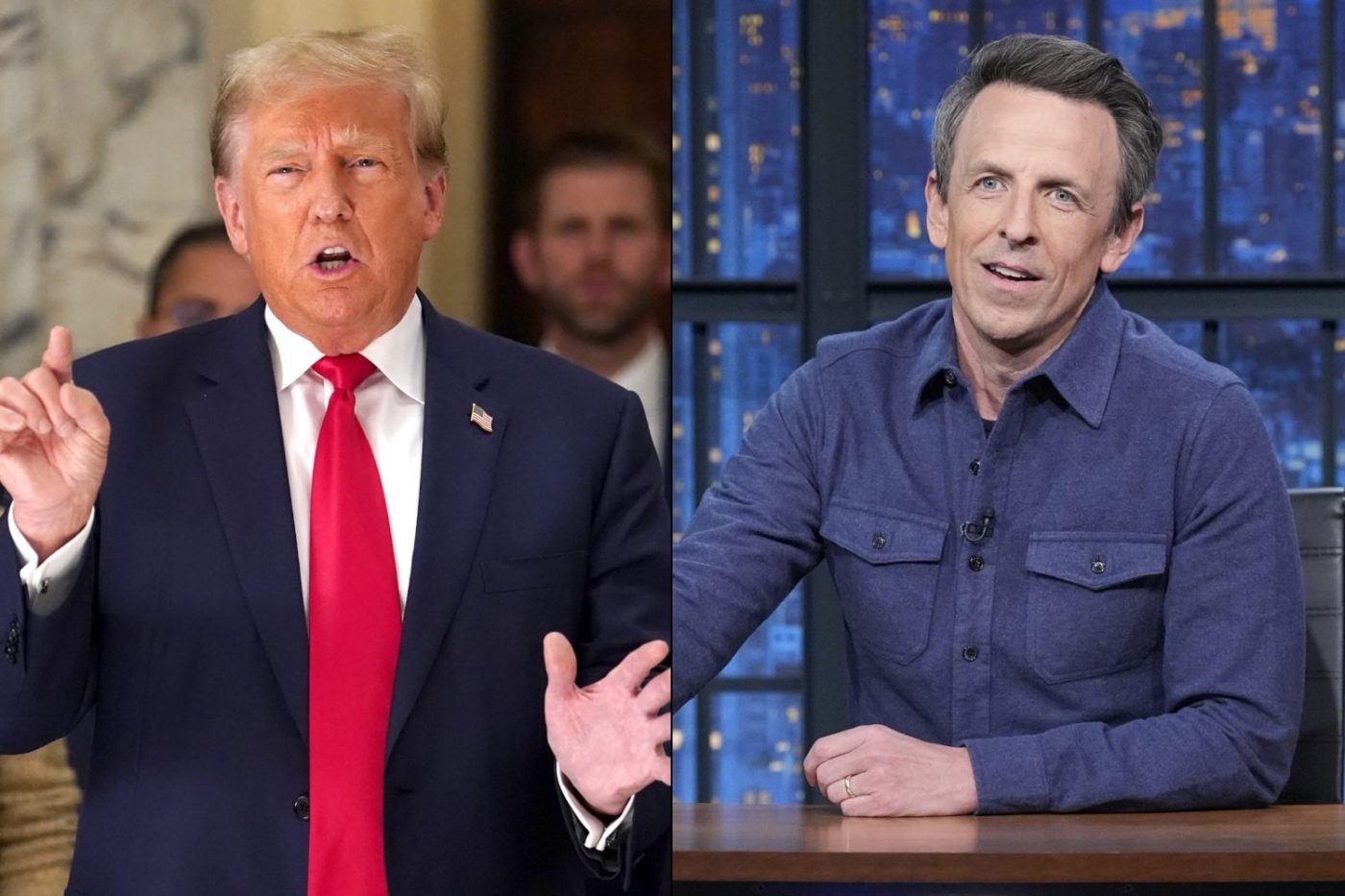

Donald Trump’s sharp reaction to a recent Seth Meyers monologue fits a familiar pattern: he treats satirical criticism as beyond the bounds of acceptable speech. After Meyers’ segment, Trump posted on Truth Social that the bit was “100% ANTI TRUMP, WHICH IS PROBABLY ILLEGAL!!!” and urged NBC to fire the host — a post that was amplified when the chair of the Federal Communications Commission reshared it.
Meyers is only the latest entertainer to draw Trump’s ire. Performers and hosts from Taylor Swift and Bruce Springsteen to Jimmy Kimmel and Stephen Colbert have all been on the receiving end of his complaints when they criticize him or his administration. Those clashes can be comic on the surface, but they also raise serious questions about free expression in the United States — particularly as the country approaches the 250th anniversary of the Declaration of Independence and the civic ideals it established.
Democratic Senator Edward Markey responded to Trump’s attack with a resolution condemning the suggestion that criticizing the president could be illegal, stressing that “criticizing the President is not a crime. It is a constitutional right.” He pointed to the First Amendment’s protection of speech and a free press. The resolution was blocked by Republicans, underscoring the partisan split over how to respond when a president attacks critics.
Trump’s posture echoes an old legal idea: crimen maiestatis from Roman law, which evolved into the European concept of lèse‑majesté — laws that make insulting a sovereign a punishable offense. Variants of that impulse remain in some modern states: Thailand and Cambodia still criminalize insults to the royal family. The instinct to shield leaders from public ridicule is consistent with expansive views of executive authority.
Historically, insults to monarchs were treated as treason and could carry brutal penalties. Over centuries, many societies moved toward press freedom, but those gains were uneven and reversible. Sweden adopted the first law guaranteeing freedom of the press in 1766, yet even that law contained exceptions for blasphemy and attacks on the king; censorship returned at times before freer practices took root.
The United States declared free speech a foundational right in 1791, but it has not been immune to curbs in times of perceived danger. The Sedition Act of 1798 criminalized ‘‘false, scandalous, or malicious’’ writings against the president and government — a measure so unpopular it helped weaken John Adams politically. The act soon lapsed, but other emergency or wartime restrictions have reappeared on occasion. In a recent parallel, the Trump administration invoked the long-unused Alien Enemies Act in an unusual immigration-deportation case, illustrating how old statutes can be repurposed.
American leaders have long wrestled with being the focus of public mockery. Thomas Jefferson, a strong defender of free speech, chafed when personally attacked but ultimately trusted public judgment. Lyndon Johnson likewise bristled at jokes about him but later admitted that being lampooned is ‘‘part of the price of leadership’’ — a recognition that satire plays a role in democratic life.
Trump’s comments suggest a different instinct: to treat hostile coverage and ridicule as potentially illegitimate or even unlawful. Critics warn that normalizing that stance risks importing a modern form of lèse‑majesté, where leaders use legal or political pressure to punish dissent and comedic critique.
The debate over these exchanges is more than a matter of personal sensitivity. It tests how much space a republic will allow for robust criticism of those in power. The American tradition of free expression has always been contested and sometimes constrained, but its preservation depends on whether institutions and leaders accept — or reject — the messy, often uncomfortable role that satire and critical journalism play in public life.


