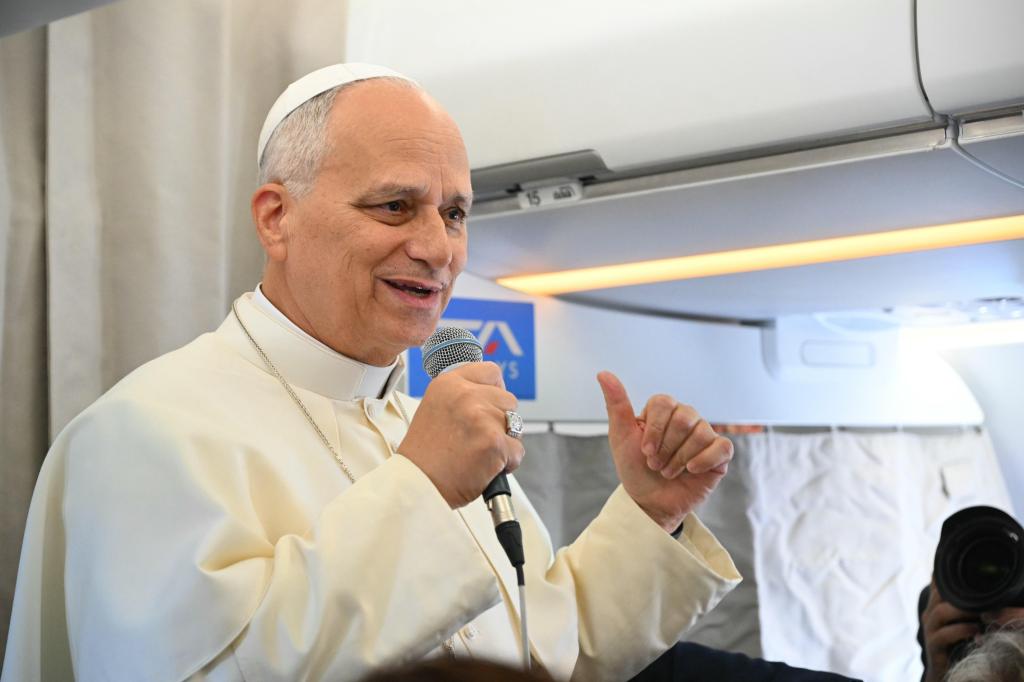

ABOARD THE PAPAL PLANE — Pope Leo XIV on Sunday doubled down on the Holy See’s insistence that a two-state solution is the “only solution” that can guarantee justice for both Israelis and Palestinians, saying so in his first airborne news conference as pope.
Leo made the remarks en route from Istanbul to Beirut on the second and final leg of his maiden papal voyage. Though he has met journalists at informal gatherings at his country house, this brief inflight encounter marked his first news conference as pope and followed the tradition of using foreign trips to engage with the media. Because of the short flight, the session was limited to two questions from Turkish journalists.
Asked about private talks with Turkish President Recep Tayyip Erdogan and whether they discussed the wars in Gaza and Ukraine, Leo confirmed they had and said Turkey has an “important role to play” in both conflicts. He noted Erdogan’s government helped facilitate low-level negotiations between Russia and Ukraine and urged continued dialogue to pursue a ceasefire and end the nearly four-year war.
On Gaza, Leo reiterated the Holy See’s longstanding support for a two-state solution, saying creation of a Palestinian state in east Jerusalem, the West Bank and Gaza has long been seen internationally as the only way to resolve the conflict. The Holy See recognized a Palestinian state in 2015, and the push for a two-state outcome gained renewed momentum during this year’s Israel-Hamas war, with several countries formally recognizing a Palestinian state at the U.N. General Assembly.
“We know that in this moment, Israel doesn’t accept this solution, but we see it as the only one that can offer a solution to the conflict that they are living in,” he said, adding that the Holy See is “friends with Israel” and seeks to be a mediating voice to help both sides reach a just solution.
There was no immediate response from Israeli Prime Minister Benjamin Netanyahu’s office. Netanyahu has long argued that creating a Palestinian state would reward Hamas and risk a larger Hamas-controlled entity on Israel’s borders. Earlier this month he said Israel’s opposition to a Palestinian state “has not changed one bit” and is not swayed by external pressure.
While in Turkey, Leo largely avoided direct mention of the Gaza conflict and did not refer to his visit to Istanbul’s Blue Mosque in his brief remarks. Instead he emphasized the trip’s primary purpose: commemorating the 1,700th anniversary of the A.D. 325 Council of Nicaea, held in present-day Iznik. The council agreed on a common creed—the Nicaean Creed—still recited by millions of Christians and a rare point of unity among Catholic, Orthodox and many Protestant believers.
Leo participated in the Iznik commemoration and spent time meeting Orthodox patriarchs. At a joint meeting Saturday, he proposed a major 2033 gathering in Jerusalem—marking 2,000 years since Christ’s crucifixion and resurrection—as a visible sign of Christian unity. “Obviously it is an event that all Christians want to celebrate,” he said, noting there are years to prepare and that the patriarchs welcomed the proposal.


