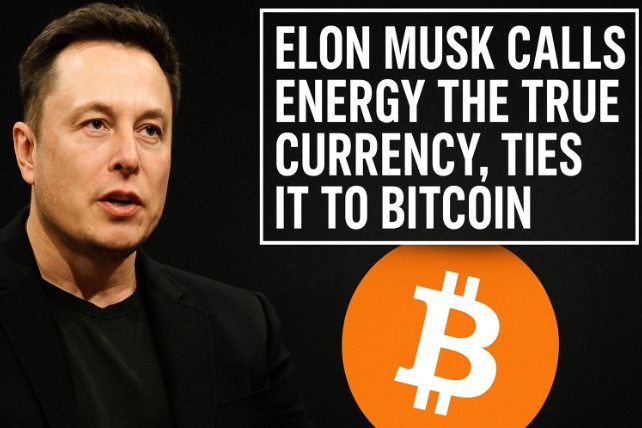

In a recent public exchange, Elon Musk argued that energy — not fiat money — should be considered the “true currency,” framing Bitcoin as a form of “energy-based” money. His remarks reignited debate about what gives cryptocurrencies like Bitcoin value amid concerns about global monetary policy, inflation, and energy use.
Why energy, not money?
Responding to a comment about global spending on AI and stimulus, Musk agreed with “you can’t print energy,” and added: “That is why Bitcoin is based on energy: you can issue fake fiat currency, and every government in history has done so, but it is impossible to fake energy.” He contrasts physical energy, a measurable resource, with fiat currencies that can be expanded through monetary policy. Musk’s point: value grounded in physical inputs is more durable and honest than value derived from government-backed, inflation-prone money.
Bitcoin as “energy money”
Musk ties this argument to Bitcoin’s proof-of-work design, which requires substantial electrical energy to mine new coins by solving computational puzzles. That energy expenditure, he argues, anchors Bitcoin’s value — energy cannot be fabricated; it must be produced and consumed. Recasting Bitcoin as a “physics-based currency,” Musk suggests its real-world energy costs distinguish it from debt- or decree-based money.
Inflation, fiat, and the debasement argument
Musk’s comments arrived amid heightened spending on AI infrastructure and other large projects that some say risk currency debasement. By presenting Bitcoin as energy-backed, he offers it as a potential hedge against fiat inflation: unlike money that can be printed, Bitcoin’s issuance and the energy required to secure it impose tangible constraints.
Evolution of Musk’s crypto stance
Musk’s stance has shifted over years — from early support to concerns about environmental impact. Tesla briefly accepted Bitcoin in 2021, then reversed that decision citing mining’s energy footprint. Now he appears to re-engage with Bitcoin, treating its energy consumption as a feature that confers value rather than merely an environmental liability.
Why it matters — and the counterarguments
Musk’s framing matters because of his influence in tech and markets. His endorsement can reshape perceptions of Bitcoin when inflation, energy use, and economic uncertainty are prominent concerns. But the “energy-as-currency” view is controversial. Critics note the environmental and societal costs of high energy use, especially from fossil fuels, and question whether energy expenditure alone guarantees stable, long-term value or sustainable scalability.
Musk’s remarks challenge conventional ideas about money and value, proposing that energy — physical, measurable, finite — could be the foundation of a monetary system. Whether one agrees or not, the perspective pushes a reevaluation of what underlies assets in a complex global economy.