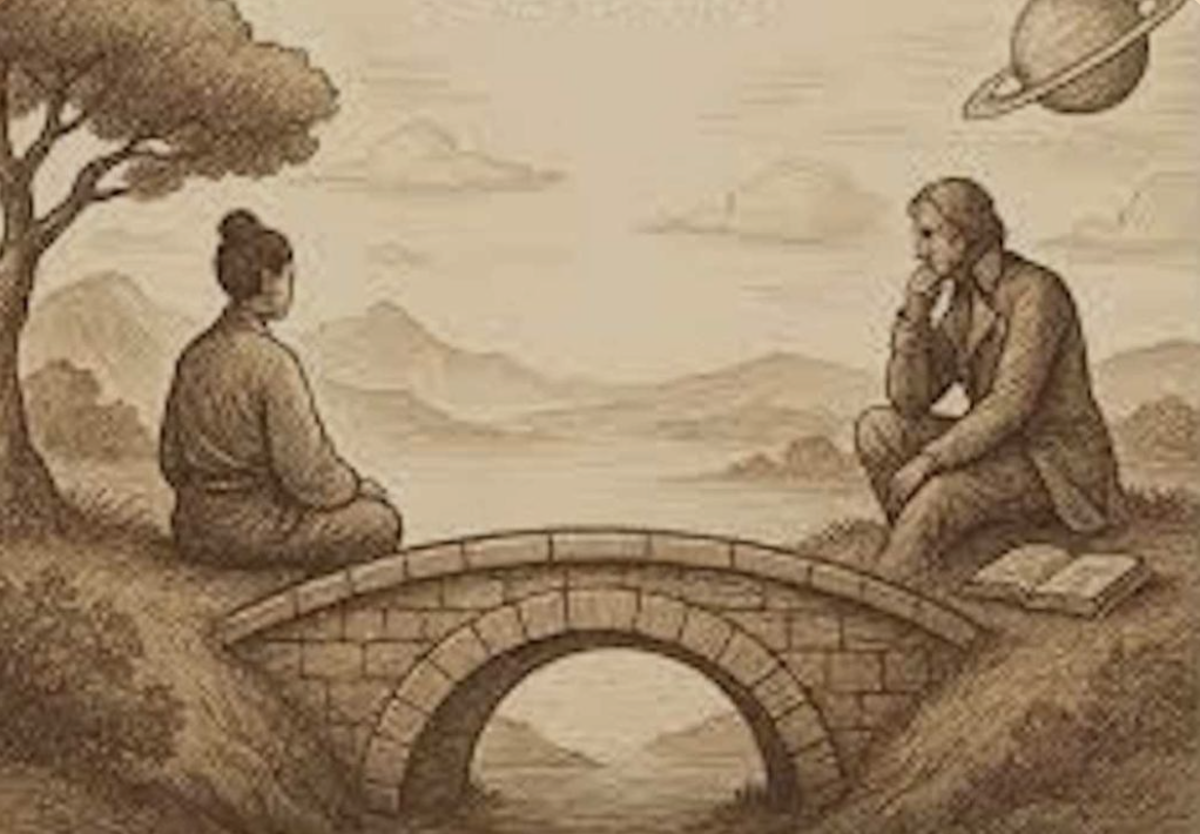

The exchange of ideas between East and West has been more than intellectual traffic; it has tracked the rise and transformation of civilizations. From Jesuit missionaries who introduced clocks and star charts to Ming China, to nineteenth-century German philologists who uncovered Sanskrit and the Upaniṣads, encounters have mixed curiosity with misreading. Western seekers commonly looked to Asian traditions to supply what their rationalist inheritance seemed to lack — inwardness, balance, and spiritual integration — while Asian observers met those efforts with admiration, irony and skepticism, asking whether Western frames could hold what Asian practices aimed to disclose.
Many well-known Western figures functioned as translators of Asian thought into European and American idioms: Schopenhauer, Emerson, Nietzsche, Jung, Hesse, Huxley, Watts, Capra and Wilber among others. Each put the East through the lens of his era, temperament and assumptions. Seen from Asia, these translations are double-edged: they opened doors and popularized unfamiliar ideas, but they also often simplified, reinterpreted or reframed sources in ways that distorted essential elements.
Early philosophical mediators
Arthur Schopenhauer was the first major Western philosopher to use Indian and Buddhist texts as systematic resources. In his account the Upaniṣads and Buddhist analyses of suffering offered a corrective to German idealism: desire drives suffering. Asian readers found Schopenhauer’s insight into dukkha convincing, yet incomplete; he emphasized negation without fully engaging the ethical and practical paths many Asian traditions prescribe for liberation. Still, his work demonstrated that Eastern metaphysics could be discussed within Western philosophical rigor.
Ralph Waldo Emerson and other Transcendentalists absorbed Vedāntic themes from the Bhagavad Gita and Upaniṣads, celebrating an inner divinity and the primacy of intuition. Indians often heard Emerson’s Vedānta as familiar theology refracted through Protestant individualism — a spiritually flavored expression of Yankee self-reliance. Friedrich Nietzsche, without sustained study of Asian scriptures, arrived at thoughts that resonate with Taoist and Buddhist sensibilities: a critique of moral absolutism, an image of cyclic becoming, and an embrace of life’s flux. Some Asian thinkers, including the Kyoto School, later read him as close to Zen’s confrontation with meaninglessness; others note that Nietzsche retains a heroic individualism that sits uneasily beside Asian nondualist teachings.
Psychology, literature and popular mysticism
Carl Jung engaged Eastern symbols and practices seriously, drawing on Taoist texts, Kundalini writings and Tibetan Buddhism. He turned the mandala into an archetype of psychic wholeness and interpreted meditative attainment as psychological integration. Asian scholars appreciate his role in bringing spiritual imagination into Western psychology but caution that Jung often reframed soteriological aims as therapeutic processes, converting radical spiritual insights into methods for personality development.
Writers like Hermann Hesse and Aldous Huxley popularized an image of a universal mystical core. Hesse’s Siddhartha and Huxley’s The Perennial Philosophy offered consolations to people alienated by industrial modernity, but critics note that such works tend to strip traditions of their disciplinary practices, lineage contexts and ethical frameworks — in short, they reproduce the words while losing the music.
Mid- and late‑twentieth-century popularizers such as Alan Watts made Zen and Taoist ideas accessible to large Western audiences, conveying nonduality with wit and clarity. That accessibility is a virtue, yet many Asian observers argue that it can trivialize practice by offering instant enlightenment as aphorism rather than a disciplined path. Fritjof Capra’s The Tao of Physics, which drew poetic parallels between modern physics and Eastern metaphysics, brought legitimacy to Asian thought among scientifically minded readers but was often seen as superficial by specialists in either domain.
System builders and integrators
Ken Wilber proposed an ambitious Integral Theory that blends Aurobindo, Buddhist insights, psychology and systems thinking into a developmental map of consciousness. For some Western readers this supplies an inclusive framework; for many Asian critics it psychologizes and stages what many traditions present as immediate recognition or non‑sequential awakening. In philosophical schools such as Advaita Vedānta or certain Zen lineages, enlightenment is not the last rung of psychological maturation but the revelation of an ever-present wholeness.
Science, metaphysics and historical pressures
These interpretive projects occurred as Western natural science rose to global cultural authority. Where traditional Chinese and Indian cosmologies envisioned an infused, organic universe, Western science popularized a mechanistic ontology: nature as object to be measured and controlled. Jesuit astronomy impressed Chinese observers with precision, but its metaphysical stance did not always displace native cosmologies until military and colonial pressures made scientific capability a matter of national survival. Reformist slogans such as “Chinese learning for essence, Western learning for application” reflect attempts to reconcile strengths, even as mechanistic models gradually reframed qi as “energy” and yin–yang as dualities, eroding older moral and cosmic resonances.
In India the colonial encounter took a different form. British education brought rationalism and technology as symbols of civilizational superiority. Indian intellectuals rearticulated spiritual vocabulary in scientific terms — Vivekananda calling yoga a science of consciousness, Sri Aurobindo describing evolution as divine self-manifestation. That synthesis enabled engagement with modernity but risked reducing transcendence to psychological or metaphysical metaphors. Colonial curricula often split classical learning from modern sciences, confining public life to empiricism while preserving an inner spiritual domain.
A partial reversal also unfolded when Western science began recognizing holistic patterns. Quantum theory, systems thinking and ecology challenged strict Newtonian reductionism. Scholars and scientists drew suggestive parallels between dependent origination and quantum interdependence; neuroscientists studying meditation found affinities with Vedāntic and Buddhist claims about consciousness. Calls for a “transcendent naturalism” aim to recover wonder and value within scientific inquiry, echoing Asian perspectives in which knowing is always bound up with being.
Toward genuine integration
The recurring pattern is familiar: Western interpreters frequently extract luminous elements of Asian traditions and recast them into forms that make sense for Western audiences — a useful but risky operation, because context, discipline and lineage often get left behind. Yet exchange has been mutual and transformative. Asian thinkers have reimagined their traditions in the light of science and modern institutions; Confucian scholars engage with ecology and climate science, Indian researchers invoke Vedāntic metaphors in consciousness studies, and Buddhist communities partner with neuroscientists to investigate meditation.
If early centuries were primarily translation, the next phase must be integration. Science cannot by itself account for the human experience of wonder; spirituality cannot ignore empirical standards and social consequences. The fertile middle ground would integrate intellect and intuition, rigorous method and contemplative depth, so that inquiry and meaning go forward together.
The Asian century and what it requires
As geopolitical and cultural influence shifts toward Asia, comprehension becomes an imperative. The rise of China, the demographic and intellectual weight of India, and the innovations coming from Japan, Korea and ASEAN require more than polite curiosity: they require cultural literacy and genuine conversation. The old reflexes of tutelage or unilateral universalism are inadequate. If the twentieth century was dominated by America and the nineteenth by Europe, the twenty-first may be characterized by Asia’s increased capacity to reunite technological prowess with long-standing ethical and spiritual resources — restoring a more balanced relationship between material progress and inner life.
A short methodological note
Adaptation and distortion are not synonyms. Adaptation attempts to rearticulate an idea across cultures while preserving its core; distortion transforms it until it is unrecognizable. Whether a translation is adaptive or distorting depends on intent, attentiveness to context and humility before the source. Comparative work inevitably simplifies, because broad traditions must be rendered legible across languages and cultures, but simplification should avoid erasure. Many of the major Western mediators of Asian thought performed necessary acts of translation that also reflected their own needs and limits; their histories tell us as much about Western intellectual life as about the Asian traditions they tried to transmit.
In the ideal outcome, the long conversation between East and West will move beyond borrowing and novelty toward a shared vocabulary in which science and spirit, analysis and awe, are not opposed but allied in the service of human flourishing.


